Charter economics, Bali and Phuket
Putting a Yacht Into Charter in Bali or Phuket: What Actually Changes
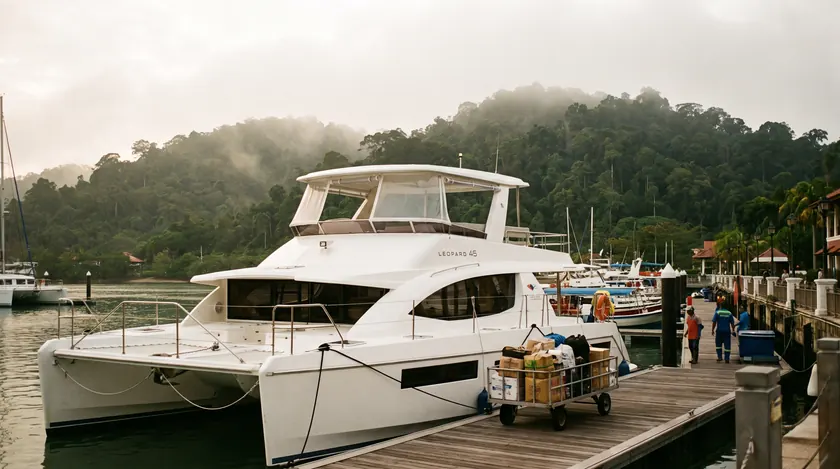
Every owner who asks about chartering a yacht in Phuket or Bali starts from the same hope: that the charter income will make the boat free to run. It will not. What it will do, reliably, is offset a real share of the ownership cost we set out in our cost of ownership guide, and the share depends heavily on which of these two markets you are in, since the rules genuinely differ.
Phuket and Bali are Southeast Asia's two established charter gateways, alongside Langkawi, but they run on different legal machinery. Thailand licenses the yacht. Indonesia licenses the operation around the yacht. Neither is harder exactly, they are just different problems, and this guide walks through both before we get to the honest math on running costs.
How much can I earn chartering my yacht in Phuket or Bali?
We are not going to hand you a percentage, because the data does not support one and neither does an honest broker. Charter revenue depends on vessel size and category, how many weeks a year it is actually booked, guest rates that vary by season and boat condition, and management overhead, all of which vary far more than a single blended figure could responsibly capture.
What we can say with confidence is the framing that matters: charter income is real and it moves the ownership math, but it offsets the roughly 10 percent of purchase value that running costs represent each year, per model, per our cost of ownership guide. It does not zero that number out, and any charter manager who tells you otherwise before seeing your specific boat, route and booking calendar is guessing the same as we would be.
What is the Thai Charter License and who qualifies?
Introduced under a 2025 Ministry of Transport framework, Royal Decree B.E. 2568, the Thai Charter License lets a foreign-flagged yacht of 24 metres and above, lowered from an earlier 30 metre threshold, carry up to 12 paying passengers for a one year license period, without re-flagging Thai. Before this reform, a foreign-flagged yacht simply could not charter for hire in Thai waters at all. On tax, a qualifying yacht pays 7 percent VAT plus 5 percent corporate income tax on charter fee revenue earned in Thailand, rather than the standard 7 percent VAT on the full yacht value that applies to an ordinary private import. A yacht under 24 metres can still charter, but only by re-flagging Thai outright, since it falls outside the new license's size window. We go through the full duty and VAT stack behind this in our Thailand import guide.
What is a CAIT and do I need one to charter in Indonesia?
CAIT was the name of Indonesia's cruising permit for foreign yachts, now processed through the online YachtERS system run by the Directorate General of Customs and Excise rather than the older paper process the acronym still gets used for. It is a temporary entry permit, typically valid around three months at a time and renewable, entering through one of 21 designated ports of entry, and it is what almost every foreign-owned charter yacht around Bali, Komodo and Raja Ampat actually cruises under. Very few internationally-owned charter yachts formally flag Indonesian or import permanently: the cabotage principle under Law 17/2008 on Shipping generally reserves Indonesian flagging to Indonesian citizens and entities, which makes the temporary-permit route the practical default rather than a workaround.
Prefer to just ask? Send a short message, we reply the same day.
Ask a questionDo I need a local company to charter my yacht in Indonesia?
In practice, yes. Foreign owners running a charter operation out of Bali typically layer in an offshore flag, Marshall Islands or Cayman Islands are the two we see most, alongside a local PMA company to hold the actual charter license. This is also where Indonesia's tax picture genuinely forks. A yacht imported permanently for private use can face the PPnBM luxury-goods sales tax at rates as high as 75 percent on top of standard import duty, a figure that has made permanent private import rare in practice. A government regulation has separately affirmed a PPnBM exemption specifically for cruise ships and yachts used in a tourism or charter business, so a vessel properly registered for commercial charter through that PMA structure faces a genuinely different tax outcome than the same boat imported privately. Standard Indonesian VAT, PPN, applies on top of duty for a permanent import either way, at 11 percent since 2022 with a further increase legislated for 2025. Verify the exact current rate and the PPnBM carve-out with an Indonesian customs broker before you structure anything, this divide needs a lawyer's sign-off, not a guide's summary.
| Factor | Bali, Indonesia | Phuket, Thailand |
|---|---|---|
| Legal route for a foreign-flagged yacht | Temporary cruising permit via YachtERS, formerly CAIT, plus an offshore flag and a local PMA company to hold the charter license | Thai Charter License, 24m and above, up to 12 passengers, 1 year, no re-flagging required |
| Tax on charter revenue | PPnBM exemption for tourism-registered vessels vs up to 75% for private import; PPN VAT around 11%, confirm current rate with an Indonesian customs broker | 7% VAT plus 5% corporate income tax on charter revenue only, not full yacht value |
| Typical permit or license duration | Around 3 months, renewable | 1 year, confirm renewal terms with the Marine Department |
| Where the demand comes from | Komodo and Raja Ampat liveaboard routes, phinisi schooners and Western catamarans out of Benoa | Andaman Sea: Phi Phi, Similan Islands, Phang Nga Bay, plus Gulf of Thailand via Koh Samui |
| Does charter income cover ownership cost | Depends on vessel, booking calendar and management, offsets but does not erase the roughly 10% of value running-cost baseline | Same variables, same baseline, depends rather than guaranteed |
Which is a better charter base, Phuket, Bali or Langkawi?
It depends entirely on what you already own and where your guests are flying from. Phuket has the deepest service infrastructure of the three, Phuket Boat Lagoon's Precision Shipwright Services alongside the newer Phuket Superyacht Shipyard, and the widest catchment of Andaman Sea cruising grounds. Bali offers Indonesia's most established charter-guest demand and the Komodo and Raja Ampat routes no other regional base can match, at the cost of a more layered legal structure to set up first. Langkawi runs a smaller crewed charter fleet, roughly 20 yachts by the counts we track, but pairs it with a genuinely duty-free registry, a different kind of advantage than either Thailand or Indonesia offers. We set out exactly how that registry works in our Langkawi duty-free guide, worth reading alongside this one if you have not settled on a base yet.
What running costs should I expect from a charter management company?
A charter manager's fee sits on top of, not instead of, the baseline running costs we walk through in our cost of ownership guide: berth, insurance, haul-out, crew if crewed, and maintenance, which we estimate model by model using a 10 percent of purchase value rule of thumb. A Lagoon 42, the most common charter catamaran across Phuket, Langkawi and Bali fleets, sits toward the lower end of that running-cost band precisely because a sailing catamaran burns less fuel than an equivalent-length motor yacht, one reason catamarans dominate the region's charter fleets in the first place. Ask any management company for its fee structure in writing against a specific boat and route before you build a return projection around it, and treat any number that ignores the underlying 10 percent baseline as incomplete.
Getting a real number for your boat
Tell us the model, which market you are leaning toward, and how far along your Indonesian corporate structuring already is if Bali is the plan, and we will walk the licensing and running-cost math through together before you commit the boat to a management contract. If you are still comparing yachts for sale in Indonesia against a Thailand-based purchase, that decision and the charter question above are worth making together, not one after the other.
Frequently asked questions
How much can I earn chartering my yacht in Phuket or Bali?
We do not quote a blended percentage because charter revenue depends too heavily on vessel size, booking calendar, season and management overhead to responsibly generalize. What holds across both markets is that charter income offsets, rather than erases, the roughly 10 percent of purchase value that ownership costs run each year.
What is a CAIT and do I need one to charter in Indonesia?
CAIT was Indonesia's cruising permit for foreign yachts, now processed through the online YachtERS system. It is a temporary entry permit valid around three months at a time, renewable, entering through one of 21 designated ports, and it is how almost every foreign-owned charter yacht around Bali actually operates rather than through permanent Indonesian flagging.
What is the Thai Charter License and who qualifies?
A 2025 reform letting foreign-flagged yachts of 24 metres and above charter in Thai waters for up to 12 passengers over a one year license period, without re-flagging Thai. Qualifying yachts pay 7 percent VAT plus 5 percent corporate income tax on charter revenue only, rather than VAT on the full yacht value.
Which is a better charter base, Phuket, Bali or Langkawi?
It depends on your boat and your guests. Phuket has the deepest service and refit infrastructure, Bali has the strongest demand for Komodo and Raja Ampat routes, and Langkawi pairs a smaller charter fleet with a genuinely duty-free registry. None is a universal answer.
What running costs should I expect from a charter management company?
A management fee adds to, rather than replaces, the baseline running costs of roughly 10 percent of purchase value a year that we use across every model. Ask for the management fee structure in writing against your specific boat and route before projecting a net return.
Weighing Bali against Phuket for your own boat
Tell us the model, your preferred base and your charter goals, and we will walk the licensing and running cost math through together.
Ask a question